One of the wonderful things about moving to France and opening our Chambres & Tables d’Hôtes has been discovering that there is a great deal more to a French meal than learning how to cook French food.
There is a rhythm to it. A sequence. An expectation about what arrives when, how long you linger over it, and—apparently—what absolutely must not arrive on the table together.
I am learning these lessons as we eat.
Lesson No. 1: Do not bring out the cheese and dessert at the same time.
This particular lesson arrived one evening around our table when I thought I was being wonderfully efficient.
The main course was finished, everyone was comfortable, the conversation was flowing, and I brought out the cheese and dessert together.
Our older French guests looked at the table.
Then they looked at me.
There was a moment of polite curiosity mixed with what I can only describe as restrained astonishment.
Fortunately, one of our younger French guests came to my rescue and explained, very kindly, that there was a cultural—and perhaps somewhat generational—difference at work. In the traditional French meal, cheese is a course of its own. It comes after the main course and before dessert.
Not beside dessert.
Not competing with dessert.
And certainly not because the hostess would like to save herself a trip to the kitchen.
Now I know!
And this is becoming one of my favourite parts of hosting in France: every table teaches us something.
Hunker down. We are going to be here for a while.
If you are accustomed to a restaurant meal where the objective seems to be getting from starter to coffee in 60 or 90 minutes, a traditional French dinner can initially feel surprisingly leisurely.
That is entirely the point.
At La Maison de la Grange, dinner might begin around 7:00 in the evening with an apéritif. This isn’t really the first course. It is the transition into the evening.
There may be wine, a kir or another drink, accompanied by a few olives, nuts or small bites. Guests arrive, settle in and meet one another. Someone asks where everyone has been that day. Another person recommends a village, château, market or brocante.
Nobody is watching the clock.
Eventually, we move to the table.
Then the meal begins
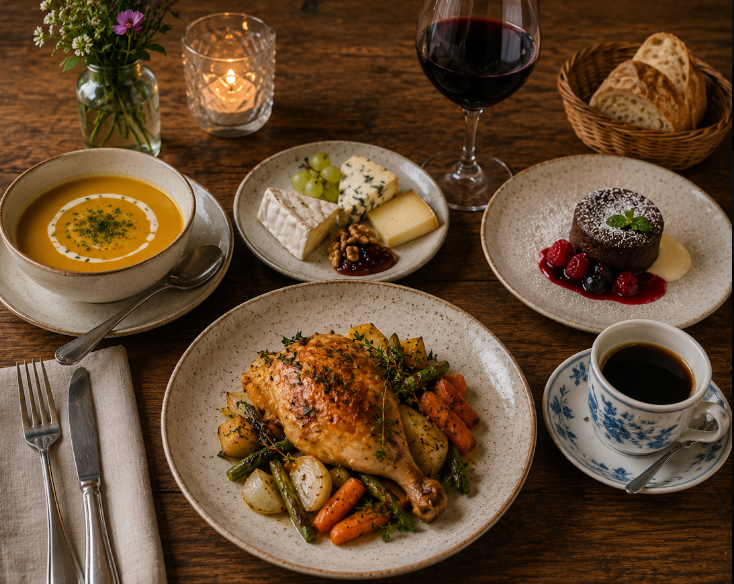
The entrée—what English speakers would generally call the starter—comes first. Depending on the season, it might be soup, melon, salad, pâté, a savoury tart or something made with whatever happens to be plentiful locally.
Then there is a pause.
The plates disappear. Wine is poured. Bread remains on the table. The conversation continues.
Next comes the plat principal: perhaps chicken, pork or another traditional dish with potatoes and seasonal vegetables. Again, there is time to eat it properly. Nobody should feel that the next plate is hovering behind them waiting for the final forkful to disappear.
And then we reach the part I now understand considerably better:
Le fromage.
Cheese comes out with bread, sometimes accompanied by a little green salad. It gets its moment.
Only after the cheese has been enjoyed and cleared away does dessert make its appearance.
Lesson learned.
Dessert is not the end, either
After dessert comes coffee or perhaps a tisane.
This was another small adjustment for me. Coffee isn’t necessarily something that arrives with dessert. Traditionally, it follows it.
And if it has been a particularly convivial evening, there might be a digestif afterwards.
By this point, something else has usually happened around the table: guests who were strangers two hours earlier are talking to one another as though they have known each other considerably longer.
That, I think, is when you begin to understand the French meal.
The pauses are part of the dinner
We are learning not to be frightened of the empty plate.
There doesn’t need to be another course arriving the instant everyone puts down their fork.
Five or ten minutes between courses gives everyone time to talk, digest and enjoy the evening. A dinner from apéritif through coffee can comfortably last two and a half hours. A special meal may last considerably longer.
The point isn’t to eat for two and a half hours.
The point is to spend two and a half hours together.
That distinction is becoming increasingly important to me.
What to expect at our Table d’Hôtes
When you join us for Table d’Hôtes at La Maison de la Grange, come prepared to settle in.
The food is important, of course. We want you to experience traditional flavours, local and seasonal ingredients, French cheeses, good bread and the simple pleasure of food made at home.
But Table d’Hôtes is also about the table.
You may be sitting beside another traveller, a French couple visiting the Creuse, guests from another country—or us. There will probably be stories. There will almost certainly be recommendations about places you should visit. There may be discussions about history, food, travel and the differences between life here and somewhere else.
There will be laughter.
And occasionally, our French guests will teach their Canadian hostess another rule she didn’t know existed.
Santé—and remember the eye contact!
We are also learning the rituals surrounding the glass.
You will hear « Santé ! », « À votre santé ! », « À la vôtre ! », « Tchin-tchin ! » and sometimes simply « À nous ! »
And when the glasses clink, look at one another.
That’s part of the ritual too.
These small customs are what make living—and eating—in France endlessly interesting. They aren’t really rules imposed for the sake of formality. They are reminders to slow down, acknowledge the people around you and give each part of the evening its place.
So when you come to stay with us, don’t rush dinner.
Hunker down. Have another piece of bread. Try the cheese. Tell us about your day.
Dessert will come.
Just not at the same time as the cheese.
I know that now.
Bienvenue à notre table.Helen
Host, La Maison de la Grange – Chambres & Tables d’Hôtes
Saint-Martial-le-Mont, Creuse, France